I didn’t set out to build a marketplace. I set out to fix a WhatsApp group.
For over a year, I ran WTFraud, a community of 600+ fraud and risk practitioners across India’s BFSI ecosystem. Lending heads, KYC product managers, compliance officers, fintech founders. The conversations were gold. The medium was garbage.
Someone asks a nuanced question about CKYC mismatch rates across vendors. Three practitioners reply with real implementation data. Forty-eight hours later, the entire thread is buried under memes, forwards, and “congratulations on the new role” messages. Gone. No search. No attribution. No way to find it again.
That gap became Fintech Circle. Claude Code is the reason it got built.
I should say this upfront: I’m not a developer. I’m a product marketer who can’t write a React component from scratch. I’ve never deployed a server. A year ago, the idea that I could ship a marketplace would have been absurd.
This is what actually happened.
The real problem: finding trusted expertise in India
Three platforms dominate professional networking in India. All three fail as marketplaces.
WhatsApp groups have the practitioners but no structure. You can’t search. You can’t segment. A question asked on Monday is invisible by Wednesday.
LinkedIn has the profiles but not the trust. No founder verification. No way to know if the person giving you lending advice has actually closed a co-lending deal.
Peerlist comes closest. Proof-of-work profiles. Builder credibility. But it’s horizontal — a fintech compliance officer and a frontend developer are treated identically. The domain context that makes BFSI expertise discoverable and transactable doesn’t exist.
Fintech Circle is a verified marketplace for BFSI expertise — where builders post queries and vetted partners respond. Restricted to one industry, locked behind a verified identity that proves you actually work in this space.
The insight: the problem isn’t features. It’s trust. If every member is a verified practitioner with a real identity, real role, and real company, the quality problem solves itself.
Why Postgres, not Supabase
Supabase is the default recommendation for solo founders. Built-in auth, realtime, storage, edge functions. I evaluated it seriously. I chose plain Postgres.
I’m already using Strapi. Strapi runs on Postgres. It manages the schema, migrations, API layer, and admin panel. Adding Supabase means two systems managing the same database. Two auth layers. Two API surfaces. Two things that can break. That’s not simplicity — it’s a coordination problem disguised as convenience.
The frugality argument: Strapi on Railway with managed Postgres: $7/month. Supabase Pro: $25/month for features I already have. Every dollar saved on infrastructure is a dollar spent on the 1,000 PAN verifications at ₹5 each that actually make this product work.
The lock-in argument: Supabase Edge Functions are Deno. Supabase Realtime is proprietary. Plain Postgres is Postgres everywhere — Railway, Render, Fly.io, Neon, AWS RDS. The data model moves with me. At my stage, portability matters more than features.
What I use instead of Supabase’s extras
| Supabase feature | What I use instead | Why |
|---|---|---|
| Auth | Strapi Auth + Next-Auth | LinkedIn OAuth, phone OTP. Strapi handles user records. |
| Realtime | Socket.io or Ably (thin layer) | Only the feed needs real-time. That’s 5% of the product. |
| Storage | Strapi Media Library + Cloudinary free tier | Image uploads, avatars. CDN-backed. |
| Edge Functions | Strapi custom routes + controllers | Verification logic, notification dispatch. No separate runtime. |
| Row-Level Security | Strapi roles & permissions | Content-level access control through admin panel. |
More pieces? Yes. Each piece the right tool at the right price? Also yes.
Why Strapi (and why the “headless CMS” label is misleading)
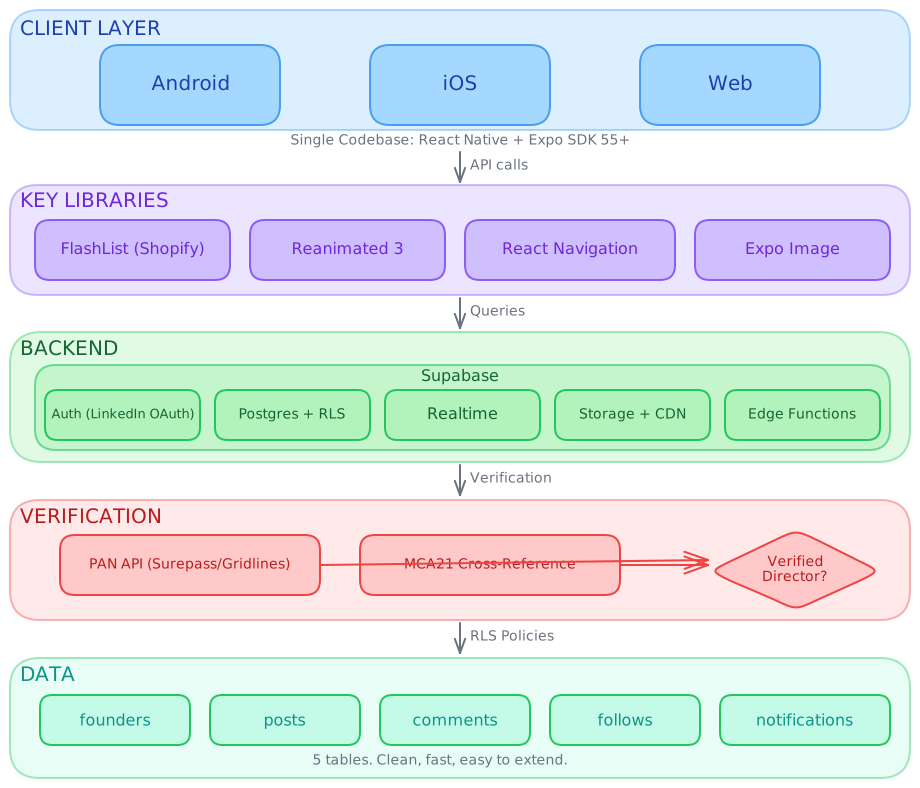
A marketplace is, at its core, a content management system with a transactional layer on top. Posts are content. Profiles are content. Listings, badges, notifications — all structured content with types, fields, relationships, and permissions.
Strapi lets me define all of this as structured content types with custom fields, relations, and validation. No SQL migrations. Define the shape of the data in the admin panel, Strapi generates the API — REST and GraphQL, both out of the box.
The admin panel is the product (for operations). Nobody tells you this about running a marketplace: 60% of the work is moderation, listing review, user verification, and operational tasks. Strapi ships with an admin panel. Review flagged posts, ban users, approve verifications — no code. This is what lets me operate a marketplace alone.
The SEO argument (this is the real killer). Strapi + Next.js gives me server-side rendered pages with full control over meta tags, structured data, Open Graph, and canonical URLs. Every post in c/Lending becomes an indexable page. Every verified profile becomes a page. Schema.org markup tells Google and AI search engines exactly what this content is and who wrote it.
The fact that nobody uses Strapi for marketplaces is a gap in imagination, not a gap in capability.
Why Lovable and vibe coding don’t work for this
I tried Lovable. I tried Bolt. I tried v0. I’m a marketer who can’t code. Of course I tried them.
They’re good at one thing: generating a pretty UI in 30 seconds. They can’t do one other thing: build a marketplace that Google can find.
The SEO problem: Every question in c/Lending needs to be a page that ranks on Google. Lovable generates React SPAs — client-side rendered. Server-side rendered pages with proper meta tags, structured data, and canonical URLs will always outrank a client-rendered app. The moment I needed SSR for SEO, vibe coding tools became irrelevant.
The AEO problem: When someone asks Perplexity or ChatGPT “which KYC vendor has the lowest mismatch rate in India?”, the answer should come from Fintech Circle. Not because I’ve gamed an algorithm, but because our content is structured, attributed, and verifiable. The answer came from a VP of Product at a Tier 2 NBFC with 6 years in lending. That context — that schema.org markup, that JSON-LD — is what AI search engines need to cite a source with confidence.
Lovable doesn’t think about structured data. For a platform where discoverability IS the growth engine, this is disqualifying.
The total cost to go live
| Line item | Monthly cost |
|---|---|
| Strapi on Railway (with Postgres) | ~$20 |
| Next.js on Vercel (free tier) | $0 |
| Expo / EAS Build (free tier) | $0 |
| Socket.io or Ably (free tier) | $0 |
| Cloudinary (free tier) | $0 |
| Monthly total | ~$20 |
| One-time costs | Amount |
|---|---|
| Apple Developer Program | $99/year (~₹8,300) |
| Google Play Console | $25 one-time (~₹2,100) |
| PAN verification (first 1,000 users) | ~₹5,000 |
| Domain | ~₹1,000 |
| Total to go live | Under ₹20,000 |
Under twenty thousand rupees. A verified marketplace on Android, iOS, and web. Server-side rendering. Push notifications. Real-time feed. Admin panel. PAN-based identity verification. Every tool is free-tier or single-digit dollars. Every tool is replaceable.
The LLM survival test
I was deep in a Claude conversation about the product architecture when it asked me something that stopped me cold: “How does this survive when ChatGPT can answer any BFSI question for free?”
I didn’t have an answer.
ChatGPT can answer “What is CKYC?” Perplexity can summarize RBI circulars. If I build a platform that stores public information and surfaces it on request, I’m building a product with a 24-month shelf life.
That conversation produced the constraint that now governs every product decision: every page and every interaction must either monetize or build a proprietary data moat that LLMs cannot replicate.
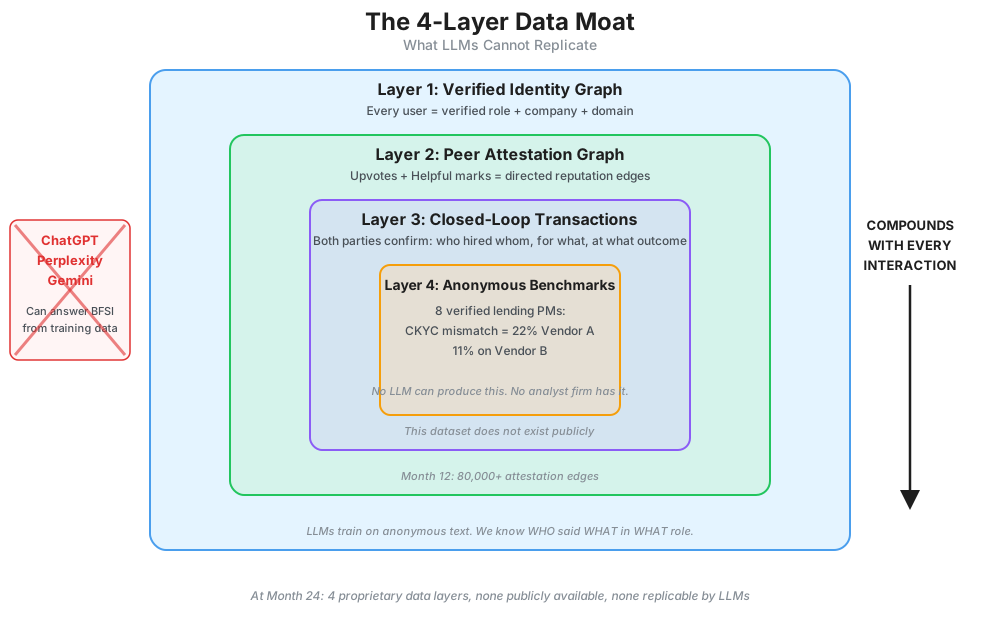
What LLMs cannot do:
- Verify that the person answering your CKYC question actually closed 12 co-lending deals
- Tell you which compliance consultant in Mumbai cleared 3 RBI audits this year and has capacity next month
- Show you 47 verified reviews from real founders about their actual settlement times with a payment gateway
- Surface the anonymous benchmark from 8 verified lending PMs showing actual CKYC mismatch rates by vendor
The moat is verified identity + peer-attested reputation + closed-loop transaction data. None of this exists in public training data. All of it compounds with every interaction on the platform. And it runs on a $7/month Postgres database.
The WTFraud advantage (why this isn’t a cold start)
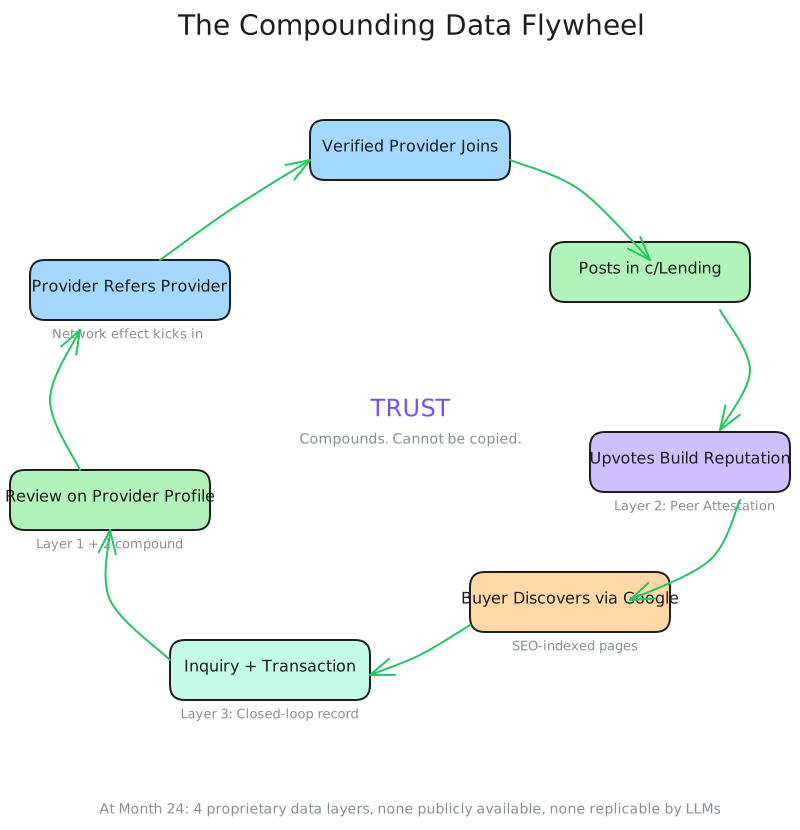
Most marketplaces die in the first 60 days. You need supply to attract demand, you need demand to attract supply.
I don’t have that problem.
WTFraud has 600+ practitioners already talking to each other every day. Already asking questions, sharing implementation details, debating vendor tradeoffs. The content exists. The community exists. The medium is the bottleneck, not the demand.
I mapped 239 real questions from five WhatsApp group transcripts (WTFraud, IFF, IITians in Fintech, FinPro, Digital Fifth). Not synthetic content. Real questions from real people with real problems. Pre-sorted by category. Ready to seed on Day 1.
A year of running a WhatsApp group taught me who the credible people are, what motivates them, what they need to feel valued. No AI tool gives you that. Earned context. Cost nothing except time and attention.
What Claude actually did
Product vision: I wrote messy notes. Claude stress-tested them, asked hard questions, structured the output. The V3 “monetize or moat” framework came from a conversation where I couldn’t explain why Perplexity wouldn’t kill my product.
Infrastructure decisions: Claude’s default answer was Supabase. I pushed back: “I’m already using Strapi. Why add a second backend?” Three conversations later, I had the Postgres-direct architecture. Claude gives you the right answer when you argue with it.
Content modeling: 25+ Strapi content types. Role-based permissions, webhook configurations, real-time layer architecture.
12-module architecture: 1,100 lines of developer reference, built in conversation. This document lets me hand the project to a developer and say “build this” without months of alignment.
Testing: 258 API tests. I described behavior. Claude wrote tests.
What Claude did not do: talk to WTFraud members. Validate the market. Build the relationships that make the seed launch possible. Those required a year of running a community and noticing what people actually struggled with.
The tool is the accelerant. The insight comes from the practitioner.
How this fits inside Cashfree
I work at Cashfree Payments. I built this because the problem I was solving with WTFraud is the same problem we face with our partner and merchant ecosystem every day.
We onboard thousands of merchants. They need developers to integrate payments, CAs to handle compliance, marketers to launch their products. Today, they ask us for referrals over email and Slack. There’s no system. No directory. No way to surface the right partner at the right time.
Fintech Circle fixes that. Our merchants find vetted partners. Our partners get business and refer merchants back. The marketplace runs on our own BPAN API for verification — every listed professional is PAN-verified through the same infrastructure we sell. We’re dogfooding our own product to power the trust layer.
The signals are valuable too. When practitioners post queries about CKYC mismatch rates or vendor reliability and verified partners respond with real implementation data, that’s structured market intelligence. It tells us which verification APIs to prioritize, which compliance workflows to build next, where the friction actually lives. The marketplace becomes a feedback loop for our own product decisions.
The Launchpad gives partners a place to showcase their tools and integrations. Developers and agencies discover our APIs through a marketplace they already use. That’s partner acquisition through utility, not ad spend.